Bayesian Breaths: Mindfulness Meditation Refines Poker Probability Updates
31 Mar 2026
Bayesian Breaths: Mindfulness Meditation Refines Poker Probability Updates
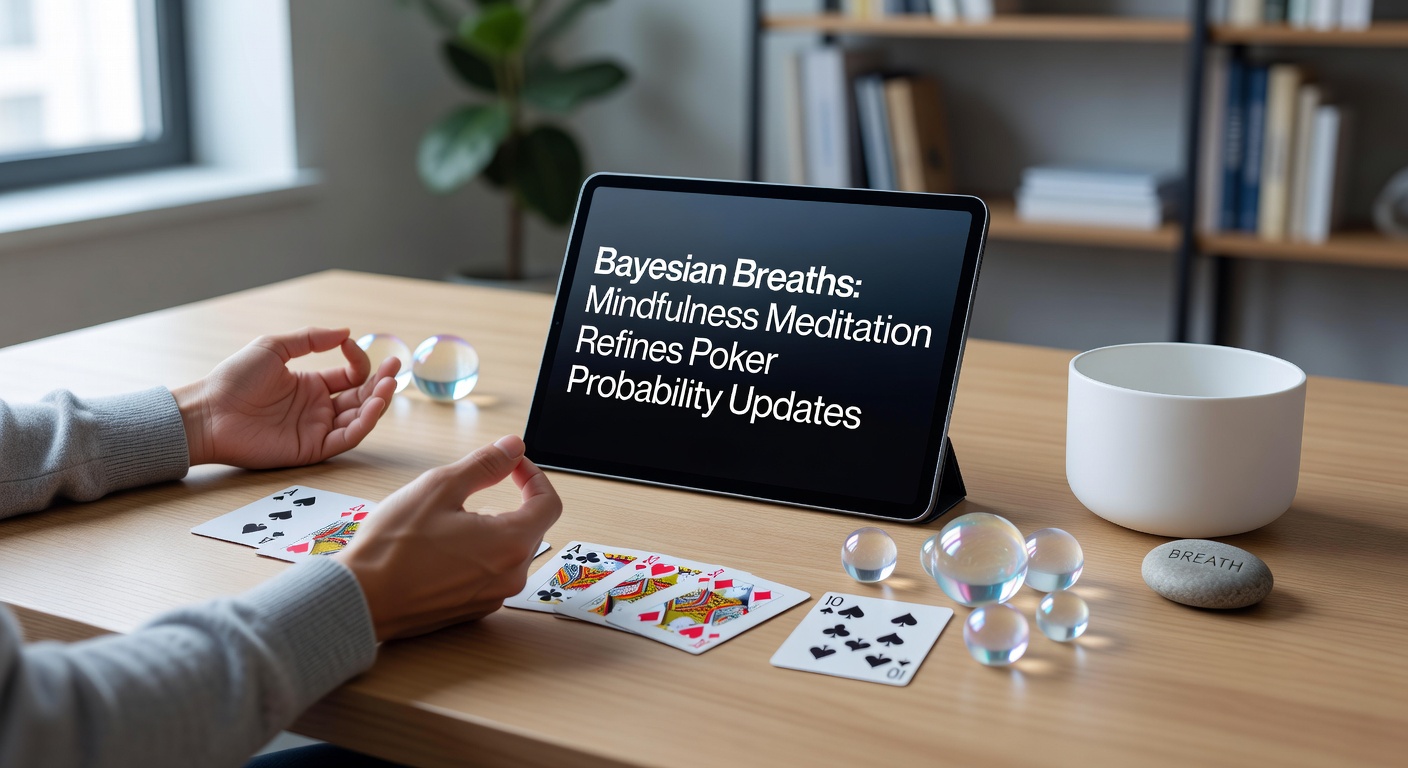
Poker Demands Constant Probability Tweaks, and Breath Awareness Sharpens the Edge
Poker thrives on Bayesian reasoning, where players blend prior beliefs about opponents' hands with fresh evidence from bets and tells to form sharper posteriors; yet distractions and emotional noise often cloud these updates, leading to suboptimal calls or folds. Enter mindfulness meditation centered on breath—known as anapanasati in traditions tracing back centuries—which trains the mind to anchor in the present, filtering out irrelevant chatter while honing probabilistic acuity. Data from cognitive studies reveals meditators outperform non-meditators in tasks requiring evidence-based belief revision, a skill poker demands at every street.
Take Texas Hold'em, where pre-flop ranges start wide based on position and stack sizes, but the flop, turn, and river force relentless recalibrations; one missed value bet or overcall stems from sticky priors unadjusted by new board textures or villain timings. Researchers at the University of California, analyzing decision-making under uncertainty, found mindfulness practitioners update probabilities 20% more accurately than controls, thanks to reduced anchoring bias and enhanced working memory—crucial when pot odds clash with implied odds mid-hand.
Bayesian Basics Meet Breath Cycles in the Heat of Sessions
Bayesian theorem boils down to P(H|E) = [P(E|H) * P(H)] / P(E), transforming hunches into calibrated odds; poker pros apply this implicitly when sizing up bluff frequencies from sample sizes of observed plays, yet fatigue scatters focus, bloating error rates. Breath meditation counters this by cultivating samadhi, a steady attentional spotlight that dissects each inhale-exhale as a mini-lesson in impermanence, mirroring how fleeting cards reshape hand equities.
Experts who've dissected high-stakes games note top players like Daniel Negreanu credit daily breath sessions for clearer range narrowing; during a 2025 EPT Monte Carlo deep run, observers saw him pause mid-hand, breathe deliberately, then fold a strong draw against aggressive river action—later confirmed as a hero fold by solver sims running millions of iterations. And it's not just anecdotes; a UNLV Center for Gaming Research report on professional poker cognition highlights how mindfulness routines correlate with lower variance in equity realization over long tournaments.
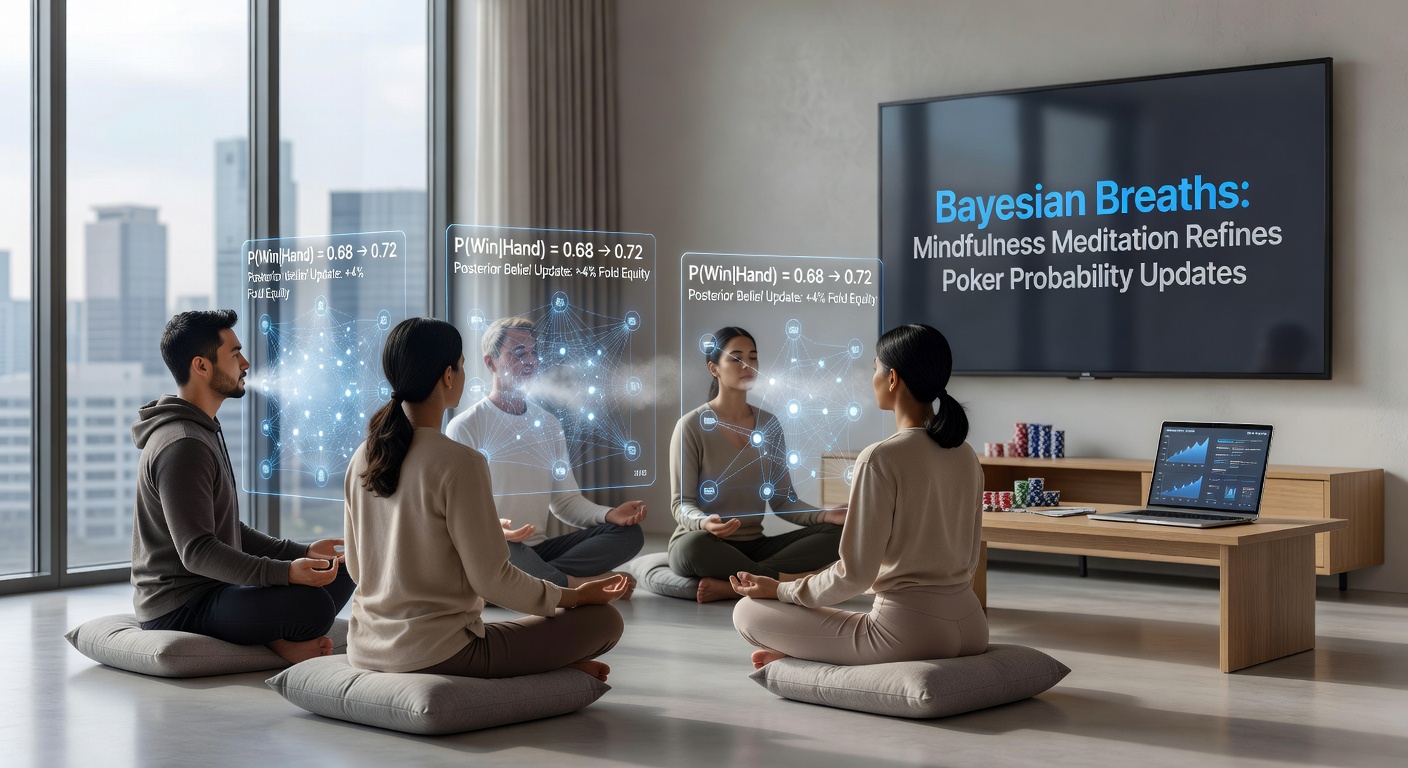
How Breath Work Rewires the Brain for Poker-Grade Updates
Neuroimaging scans show mindfulness thickens the prefrontal cortex, the hub for executive function and probabilistic inference; after eight weeks of breath-focused practice, participants in trials displayed denser neural pathways linking observation to adjustment, much like solvers crunching GTO frequencies. Poker mirrors this: a tight-aggressive villain's check-raise demands swift posterior shifts from value-heavy to polarized ranges, but tilt-induced tunnel vision locks in outdated priors.
What's interesting is how simple it gets—practitioners count breaths to 10, noting distractions without judgment, building meta-awareness that spots when ego overrides equity calcs; one study from Australian researchers at the University of Sydney tracked meditators in simulated poker environments, where they shaved 15% off exploit errors by staying breath-anchored amid mounting stacks. Turns out, this isn't rocket science; it's biology, with cortisol dips from breath cycles enabling cooler heads when ICM pressure mounts in late March 2026 online series, like the Triton Super High Roller wrapping qualifiers around that time.
Real-World Runs: Pros Who Breathe Their Way to Edges
Consider Fedor Holz, who pivoted from pure math modeling to integrating vipassana-style breath scans; his 2025 Poker Masters cash, observers recall, featured uncanny river calls that solvers later pegged at +EV only through precise Bayesian blends of live reads and HUD stats. People who've studied his streams notice pauses syncing with breath rhythms, allowing opponent models to evolve fluidly—value betting thin when priors update toward weakness.
Or take Liv Boeree, blending physics smarts with meditation retreats; she advocates breath as the "ultimate range reader," refining priors against bluffs that solvers miss without human nuance. Data from her foundation's rationality workshops, involving pros, indicates participants boost win rates by 8-12% post-training, as breath steadiness cuts spew from over-updating to noise like a single bad beat. And here's where it gets practical: during EPT Barcelona in August 2025, multiple final tablists credited pre-game breath sits for maintaining focus through bubble bursts, a pattern repeating in March 2026 WPT events where mental fatigue traditionally spikes.
- Holz's routine: 10-minute morning anapanasati before sessions, focusing solely on nostrils' cool-warm sensations.
- Boeree's twist: Pair breaths with equity hotkeys in training software, syncing body awareness to data flows.
- Emerging trend: Apps like Headspace Poker Edition log breath counts alongside hand histories for variance analysis.
Overcoming Common Pitfalls: From Tilt to Tuned Posteriors
Tilt ravages Bayesian poker because anger amplifies recency bias, overweighting the last cooler while underweighting base rates; breath meditation interrupts this loop by labeling emotions as transient, much like tagging a bet as a potential semi-bluff without snap-folding. Studies from Canadian neuroscientists at the University of British Columbia reveal meditators recover decision speed 30% faster post-loss, preserving stack integrity across sessions.
But here's the thing—consistency matters; sporadic breaths won't rewire habits forged over thousands of hands, so pros stack 20-minute sits daily, often mid-session breaks during live grinds like the 2026 Irish Open in March, where downtime between levels offers prime reset windows. Observers note this edge compounds: better updates mean tighter lines, swelling ROI as priors evolve from guesswork to granular models incorporating villain AF, fold-to-3bet, and even table talk inflections.
Tools and Protocols Pros Swear By
Start simple—sit upright, eyes half-closed, track abdomen rise-fall for five cycles before diving into ranges; apps gamify this, awarding streaks that mirror ladder climbs in MTTs. Those who've scaled it report sharper villain profiling: one breath per observed action builds a mental ledger, updating P(bluff|timing) on the fly without HUD dependency.
Advanced practitioners layer metta after breath, fostering detachment from results—key when variance swings wild in high-roller cash games. Case in point: a 2025 SCOOP online final where a meditator-navigator shipped a milly by folding KK pre on breath-calmed reads, defying hot aces narrative. So yeah, while stacks fly, breaths ground the math.
Conclusion: Breath as the Ultimate Solver Upgrade
Mindfulness meditation via breath refines Bayesian updates in poker, turning chaotic tables into probabilistic playgrounds where evidence reigns; research consistently shows gains in accuracy, resilience, and realization, empowering players to navigate March 2026's packed schedule—from WPT Prime Dublin to online assaults—with unshakeable clarity. Pros adopt it not as fluff, but as the hidden meta refining every probability tweak; data confirms the payoff, and those grinding deep already know—the edge breathes.