18 May 2026
Breathing Practices and Strategic Calculations in Card Games
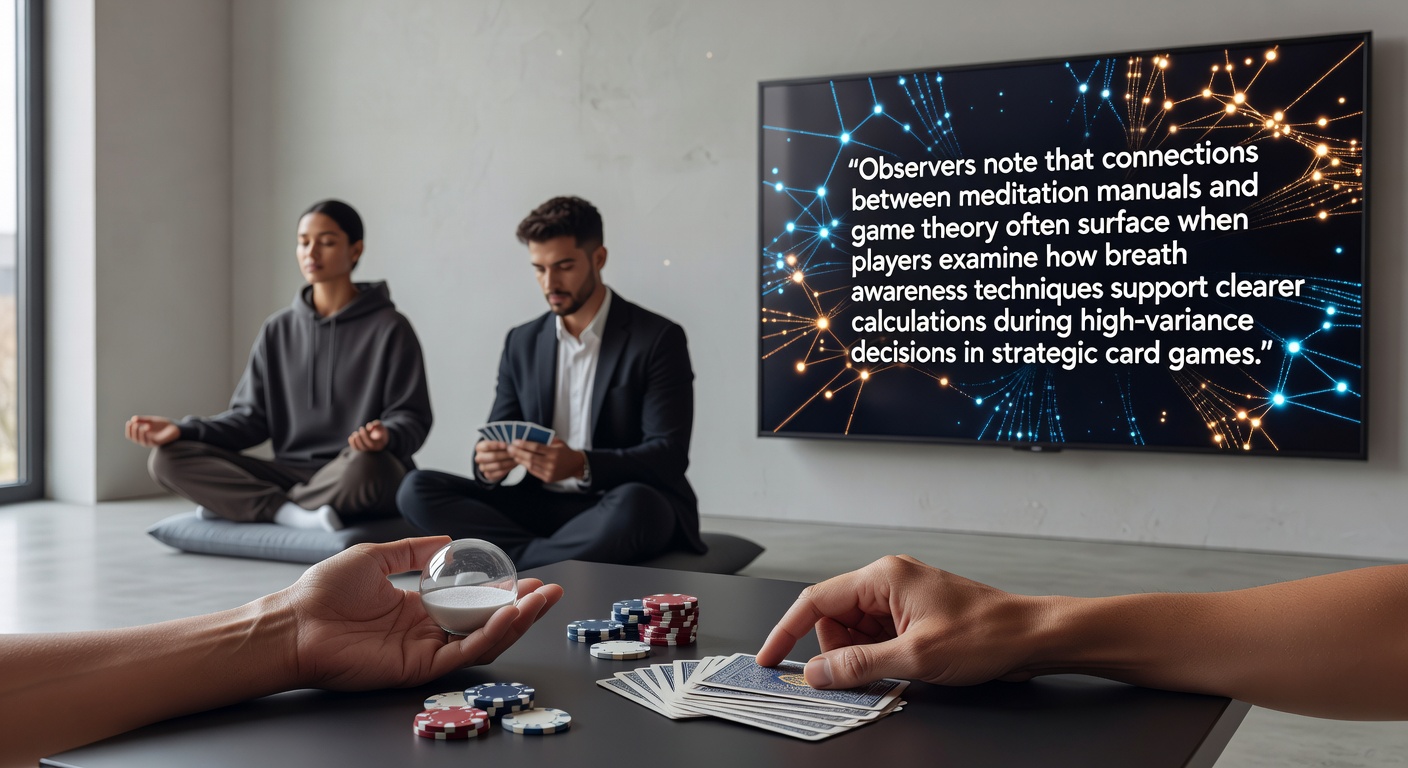
Observers note that connections between meditation manuals and game theory often surface when players examine how breath awareness techniques support clearer calculations during high-variance decisions in strategic card games. Ancient texts on breathing practices describe methods for stabilizing attention, and modern analysts apply similar approaches to maintain focus when assessing probabilities in games such as poker, bridge, and blackjack.
Research from cognitive science indicates that controlled breathing influences prefrontal cortex activity, which supports executive functions including risk assessment and sequential planning. Data from university laboratories show participants who completed brief breath-focused sessions before probability tasks recorded improved accuracy in updating beliefs based on new information, a process central to game-theoretic modeling.
Foundational Elements of Breath Awareness
Meditation manuals outline steps for directing attention to inhalation and exhalation cycles without altering natural rhythm. Practitioners count breaths or observe sensations at the nostrils to anchor awareness. These instructions appear in multiple traditions yet share a common structure: sustained observation paired with non-reactive acceptance of distractions.
Those who study these texts alongside decision theory point out parallels with iterative reasoning in extensive-form games. Each breath cycle functions like a repeated stage in a repeated game, allowing the mind to reset and incorporate the latest observation before the next choice arises. Laboratory experiments confirm that individuals trained in such observation maintain steadier heart-rate variability, correlating with steadier performance on tasks that require tracking multiple possible opponent strategies.
Application to High-Variance Scenarios
Card games frequently present situations where outcomes depend on incomplete information and random draws. In these moments, players must compute expected values across branching possibilities while managing emotional responses to recent losses or wins. Breath awareness supplies a practical mechanism for returning attention to the current decision node rather than lingering on prior results.
One documented case involved a group of tournament participants who integrated four-count inhalation and six-count exhalation pauses between hands. Subsequent analysis of their hand histories revealed tighter adherence to precomputed ranges during later stages of play, when stack depths created elevated variance. Independent reviewers noted fewer deviations from equilibrium strategies compared with control sessions lacking the breathing protocol.

Integration With Equilibrium Concepts
Game theory supplies solution concepts such as Nash equilibria for finite games and subgame-perfect equilibria for sequential play. Calculating these solutions in real time demands rapid mental simulation of opponents' best responses. Breath awareness appears to reduce cognitive load associated with emotional interference, freeing working memory for the necessary enumerations.
Studies published through academic institutions in North America and Europe demonstrate that short mindfulness interventions improve performance on Bayesian updating exercises, which mirror the belief revision required in poker hand reading. Participants exhibited faster convergence toward accurate posterior probabilities after receiving new card information. Observers therefore examine whether regular breathing practice could serve as a low-cost adjunct to existing study routines focused on solver output.
What's interesting is the timing of these techniques within a session. Players often insert brief awareness checks immediately before committing significant chips, treating the breath as a delimiter between information gathering and action selection. This mirrors the separation between information sets and move selection in formal game representations.
Broader Patterns Across Player Populations
Surveys conducted by player forums and training platforms indicate growing interest in combining contemplative methods with technical study. While adoption rates remain modest, those who maintain consistent breath routines report subjectively longer periods of sustained concentration during multi-day events. Objective metrics such as voluntary session length and error rates on routine calculations have yet to appear in large-scale peer-reviewed datasets, yet smaller pilot studies continue to track these variables.
Regulatory bodies outside the United Kingdom, including agencies in Australia and Canada, have examined player welfare programs that incorporate stress-reduction modules. Although these programs emphasize general mental health rather than game-theoretic precision, the underlying breathing exercises overlap with techniques discussed in meditation literature. Analysts therefore watch for potential crossover effects that might appear in longitudinal performance data.
Future Directions and Measurement Challenges
Quantifying the precise contribution of breath awareness to strategic accuracy remains difficult because controlled trials must isolate the intervention from concurrent study habits. Researchers at several European universities have begun designing protocols that compare solver-assisted review alone against the same review augmented by structured breathing drills. Early results suggest additive benefits on tasks measuring resistance to tilt-induced deviations, though larger samples are required before firm conclusions emerge.
Meanwhile, software developers have started embedding optional breathing timers within training applications, allowing users to practice awareness pauses while reviewing hand histories. These tools provide another data channel for examining whether deliberate breathing correlates with improved retention of complex range constructions.
Conclusion
The intersection of meditation-derived breathing practices and game-theoretic analysis in card games continues to attract attention from both practitioners and researchers. Evidence gathered so far points to measurable effects on attention stability and belief updating, yet comprehensive longitudinal studies are still developing. Players and analysts alike continue to test how these ancient instructions translate into clearer calculations amid the variance inherent in strategic card play, while measurement frameworks evolve to capture the relevant performance indicators.