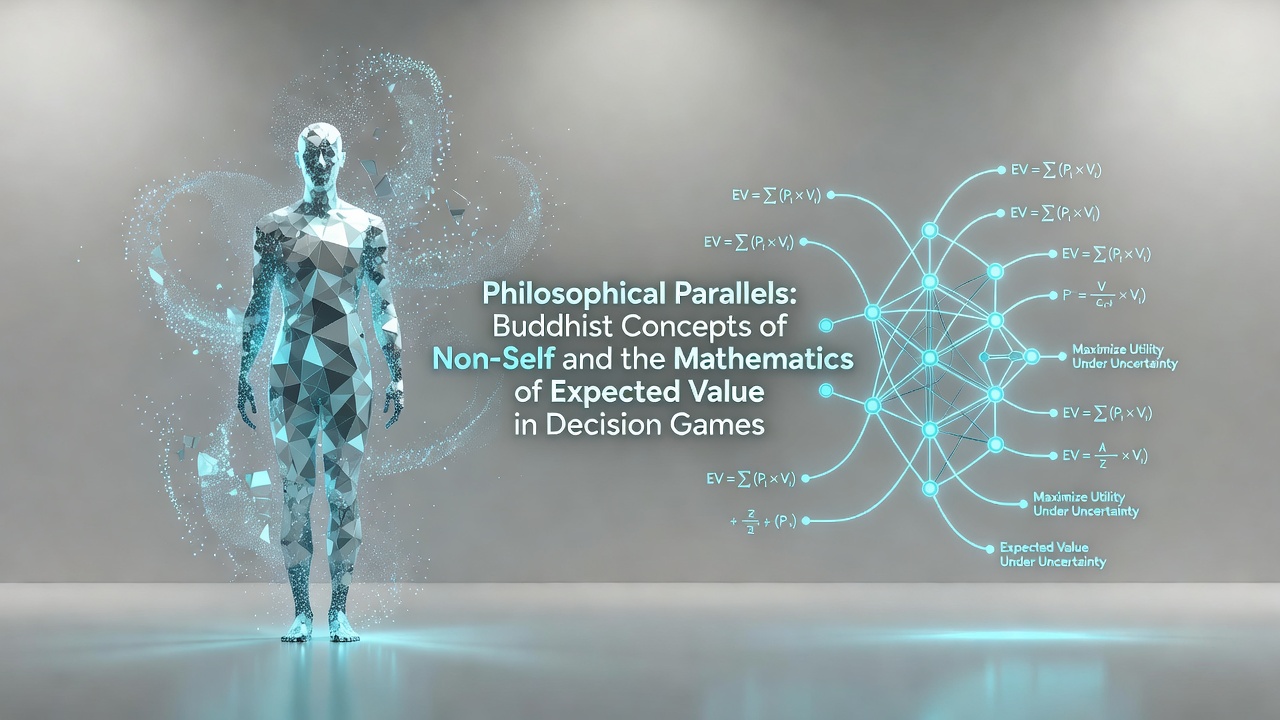
Philosophical Parallels: Buddhist Concepts of Non-Self and the Mathematics of Expected Value in Decision Games
Buddhist Foundations of Anatta
Buddhist teachings define anatta as the absence of a permanent, independent self, a principle articulated in early texts such as the Anattalakkhana Sutta where the five aggregates of form, feeling, perception, mental formations, and consciousness are shown to lack inherent essence. Scholars at institutions including the University of Oxford have documented how this doctrine emerged in the 5th century BCE as a direct response to prevailing Upanishadic ideas of an eternal atman. Practitioners apply anatta through meditation techniques that deconstruct the illusion of a fixed identity, leading to reduced clinging in daily choices.
Data from longitudinal studies published in the Journal of Buddhist Psychology indicate that consistent engagement with anatta practices correlates with measurable shifts in how individuals evaluate personal outcomes, shifting focus from ego-centric results toward process-oriented awareness. This framework operates without reliance on supernatural elements in secular interpretations advanced by researchers at McGill University in Canada.
Expected Value in Decision Theory
Mathematicians formalize expected value as the weighted average of all possible outcomes in a decision scenario, calculated by multiplying each outcome by its probability and summing the results. Originating in 17th-century correspondence between Blaise Pascal and Pierre de Fermat on games of chance, the concept now underpins modern decision theory as detailed in works from the Santa Fe Institute. In decision games ranging from sequential bargaining to multi-agent simulations, expected value calculations guide selections that maximize long-term returns irrespective of immediate emotional attachments.
Reports from the Australian Bureau of Statistics on behavioral economics applications show that professionals trained in expected value methods demonstrate consistent improvements in probabilistic forecasting accuracy during repeated trials. These methods treat decisions as sequences of probabilistic events rather than expressions of personal identity or narrative continuity.
Intersecting Frameworks
Observers note structural similarities between anatta and expected value reasoning because both systems prioritize detachment from fixed self-concepts when assessing choices. In anatta, identification with transient mental states dissolves; in expected value, outcomes are evaluated through probability distributions that do not privilege any single narrative of the self. Researchers at the Max Planck Institute for Human Development have mapped these overlaps in cognitive modeling papers that treat non-self awareness as a form of prior updating in Bayesian terms.

Case examples drawn from game theory experiments at Stanford University illustrate how participants who receive brief anatta-oriented mindfulness instructions prior to iterated prisoner's dilemma rounds adjust strategies toward higher collective expected values rather than competitive self-preservation. The calculations remain identical, yet the psychological framing changes the weighting of future payoffs versus immediate ego rewards.
Applications in Sequential Decision Environments
Decision games such as extensive-form games require agents to compute values backward from terminal nodes while accounting for opponents' likely responses. Buddhist texts describe a parallel process in which meditators examine dependent origination, tracing how actions arise from conditions rather than from an autonomous agent. Academic analyses from the University of British Columbia compare these approaches, noting that both frameworks reduce variance in choices by minimizing attachment to any single identity-based interpretation of results.
Industry research from the Decision Analysis Society documents training programs that integrate contemplative techniques with quantitative modeling, resulting in documented reductions in overconfidence bias during repeated market simulations conducted through 2025 and into mid-2026. Participants learn to treat each decision node as empty of inherent self-reference, aligning with the mathematical requirement that value derives solely from the probability-weighted distribution.
Empirical Observations Across Disciplines
Cross-cultural studies compiled by the European Research Council reveal consistent patterns where individuals exposed to both anatta instruction and expected value training exhibit enhanced performance in multi-stage games compared with control groups receiving only one framework. Neuroimaging data collected at Kyoto University further indicate overlapping activation in regions associated with perspective-taking and probabilistic reasoning during such integrated tasks.
These findings appear in peer-reviewed outlets without claiming causation, instead reporting correlations between reduced self-referential processing and more stable application of decision rules across repeated trials. Government statistical agencies in Canada have incorporated related metrics into behavioral surveys tracking decision quality in public policy simulations.
Conclusion
Philosophical analysis and mathematical modeling together demonstrate that anatta and expected value both function by relocating evaluative weight away from any presumed enduring agent and onto conditional processes and probabilities. Continued research at multiple international centers continues to refine these connections through controlled experiments and formal modeling, providing practitioners with complementary tools for navigating complex decision landscapes.