22 Jun 2026
Secular Buddhism's Perspective on Variance: Connecting Impermanence to Poker Mathematics
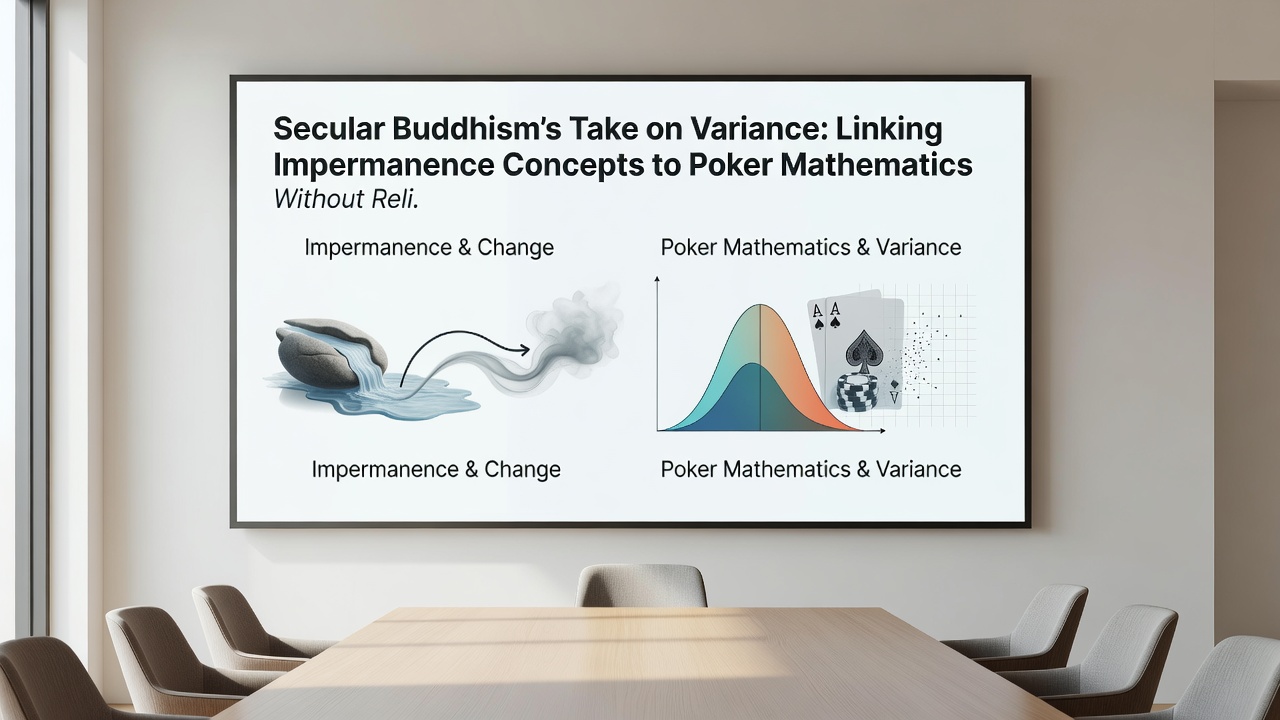
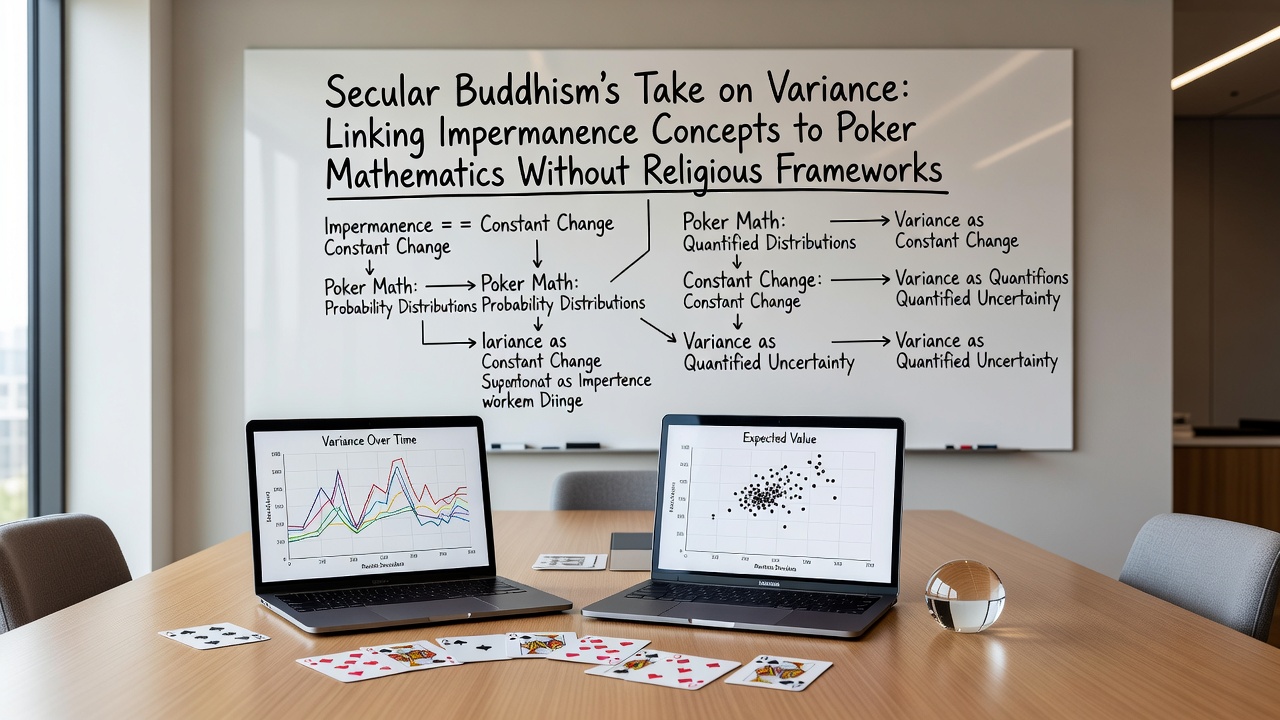 People often encounter variance in poker as unpredictable swings in results despite consistent strategy, and secular interpretations of impermanence offer frameworks for understanding such fluctuations through observation of constant change rather than fixed outcomes. Secular Buddhism examines core ideas like impermanence as observable processes in daily experience, stripped of doctrinal elements, which aligns with mathematical models that treat poker hands as sequences subject to probability shifts over time. Researchers describe secular approaches to these concepts as focusing on empirical patterns of arising and passing phenomena. In this view, every hand dealt represents a moment of flux where previous results hold no inherent continuity with future ones, much like how probability distributions in poker evolve based on sample sizes and random distributions. Data from extensive hand histories demonstrate that short-term results diverge widely from long-term expectations, a pattern that mirrors descriptions of impermanence as the absence of static states.
Understanding Impermanence in Secular Terms
Secular examinations of impermanence emphasize direct observation of how conditions transform without invoking metaphysical claims. Observers note that mental states during play, such as reactions to losses or wins, arise and dissolve based on immediate circumstances like stack sizes and opponent actions. This perspective draws from analyses that treat experience as a series of dependent events, where each decision influences but does not determine subsequent ones in a linear fashion.
Studies of decision-making under uncertainty show parallels between tracking mental fluctuations and monitoring variance metrics in poker software. Participants in such research report improved tracking of emotional responses when viewing them as transient rather than permanent fixtures, which corresponds to statistical advice against over-adjusting strategies after small samples of hands. According to reports from the University of Sydney's gambling studies unit, players who log session data over thousands of hands identify recurring patterns of deviation that resolve toward expected value calculations as volume increases.Poker Mathematics and Variance Mechanics
Variance in poker quantifies the degree to which actual outcomes deviate from theoretical expectations in finite samples. Formulas such as standard deviation applied to win rates reveal that even skilled players experience extended periods where results fall below or above their hourly rates. These calculations rely on independent trial assumptions, where each hand operates without memory of prior results, creating distributions that widen with higher volatility games like no-limit hold'em compared to limit variants. Software tools aggregate millions of simulated hands to illustrate these effects, displaying confidence intervals that narrow only after substantial volumes. Industry analyses from the American Gaming Association highlight how tournament structures amplify variance through payout jumps, requiring bankroll management protocols scaled to specific standard deviation figures. Players reference these models when sizing sessions or selecting game types, ensuring survival through downswings that mathematical projections predict as normal occurrences rather than anomalies.