24 Jul 2026
Secular Dharma and Expected Value: Rethinking Decisions at the Live No-Limit Table
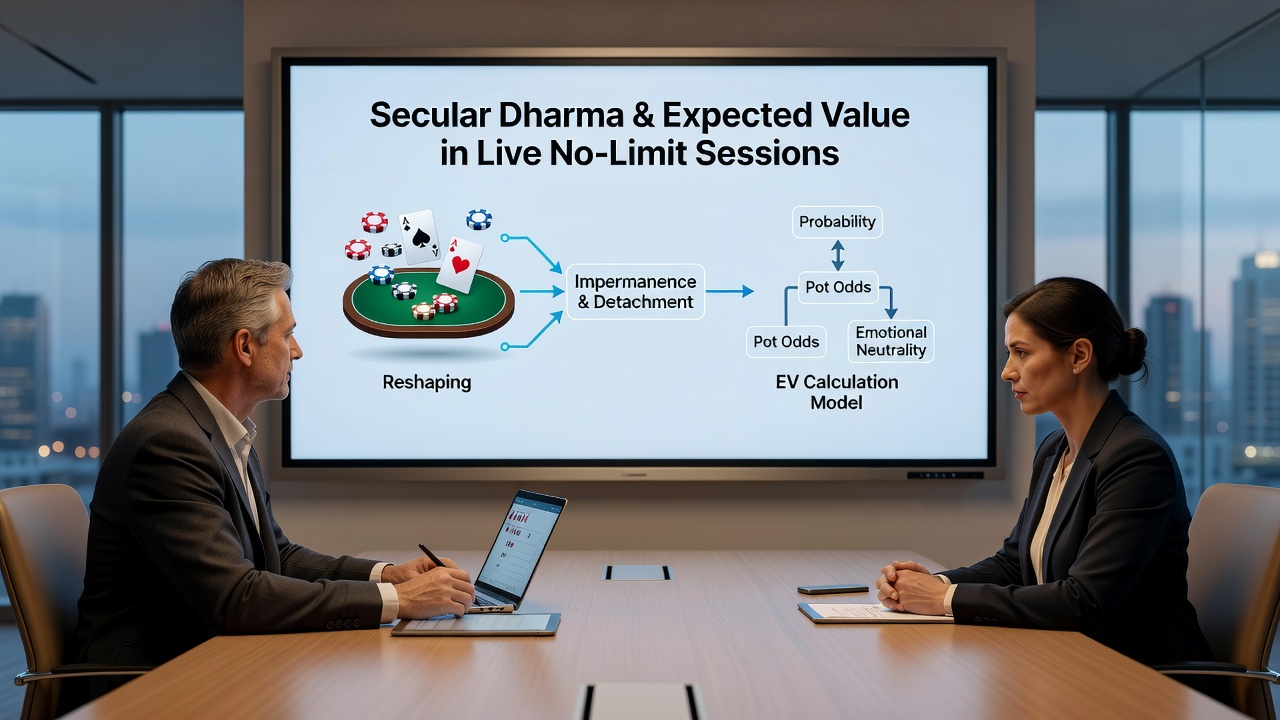
Secular dharma concepts, drawn from adapted Buddhist principles without religious frameworks, have entered discussions around poker strategy in recent years, particularly where expected value calculations meet the pressures of live no-limit sessions. Observers note that players apply ideas such as impermanence and non-attachment to refine how they weigh pot odds, implied odds, and equity realizations under real-time conditions.
Core Concepts from Secular Dharma in Decision Frameworks
Secular dharma emphasizes present-moment awareness and acceptance of changing circumstances, elements that researchers have linked to improved focus in high-stakes environments. In live no-limit hold'em, this translates to players maintaining clearer assessments of hand ranges and bet sizing even after facing repeated beats or long downswings. Data from poker training platforms indicates that participants trained in mindfulness practices show measurable differences in session length before tilting patterns emerge, which in turn affects the accuracy of their ongoing EV recalculations.
Those who've studied decision-making under uncertainty point out that attachment to specific outcomes can distort probability estimates. Secular approaches encourage recognition that each street remains independent of prior results, allowing players to reset mental models without carrying forward emotional residue from earlier hands. This adjustment matters most in multiway pots where live reads and timing tells add layers to standard mathematical models.
Real-Time EV Adjustments Through Present-Moment Awareness
Live sessions introduce variables absent from theoretical solvers, including physical tells and table dynamics that shift rapidly. Practitioners of secular dharma techniques report using breath-focused attention to stay anchored during betting rounds, which supports more precise evaluation of fold equity and reverse implied odds. Studies from institutions such as the University of Nevada, Las Vegas have examined similar attention protocols in gambling contexts, finding correlations between sustained focus and reduced deviation from optimal bet sizes.
And yet the integration goes further than simple concentration. Recognition of impermanence helps players treat each hand as a discrete event rather than part of a narrative of winning or losing sessions. This separation prevents the common error of adjusting aggression levels based on recent results instead of current stack depths and position. Figures from major tournament series in July 2026 showed consistent patterns among players who maintained steady EV thresholds across varying emotional states.

Handling Variance and Emotional Variance in Calculations
Variance in no-limit poker often triggers reactive adjustments that stray from pre-session EV models. Secular dharma frameworks address this through acceptance of uncertainty without resistance, a stance that researchers have connected to steadier adherence to bankroll management rules. Players who incorporate these ideas tend to avoid chasing losses by overvaluing speculative hands later in sessions, preserving the integrity of their original equity calculations.
One documented case involved a professional who integrated short meditation intervals between orbits during a major European festival. Records from that event revealed fewer deviations from planned continuation bet frequencies compared to previous appearances, suggesting that non-reactive observation supported more consistent application of game theory optimal strategies. Similar patterns appear in reports from Australian poker communities where mindfulness modules have been added to training regimens.
Practical Integration in Live Environments
Implementation typically begins with pre-session grounding exercises that establish a baseline for monitoring mental states during play. As hands progress, players reference internal cues to detect when attachment to winning a particular pot begins influencing bet sizing decisions. This monitoring allows recalibration toward pure expected value considerations based on available information rather than emotional momentum.
Industry reports from the American Gaming Association highlight growing interest in mental performance tools among both recreational and professional segments. While direct causation remains under study, correlations between sustained attention practices and prolonged adherence to preflop charts have appeared in multiple datasets. The approach does not replace mathematical modeling but supplements it by reducing noise introduced through psychological factors.
Conclusion
Secular dharma concepts continue to intersect with poker analysis by providing tools for maintaining decision clarity amid the inherent uncertainties of live no-limit play. Evidence from academic and industry sources shows measurable effects on how players sustain their expected value frameworks across extended sessions. As data collection expands through 2026 and beyond, further patterns may emerge regarding the specific mechanisms through which present-moment awareness refines equity assessments at the table.