Vipassana Variance: Buddhist Insight Meditation Sharpens Poker Pros' Game Theory Edge
16 Mar 2026
Vipassana Variance: Buddhist Insight Meditation Sharpens Poker Pros' Game Theory Edge

Unpacking Vipassana in the High-Stakes World of Poker
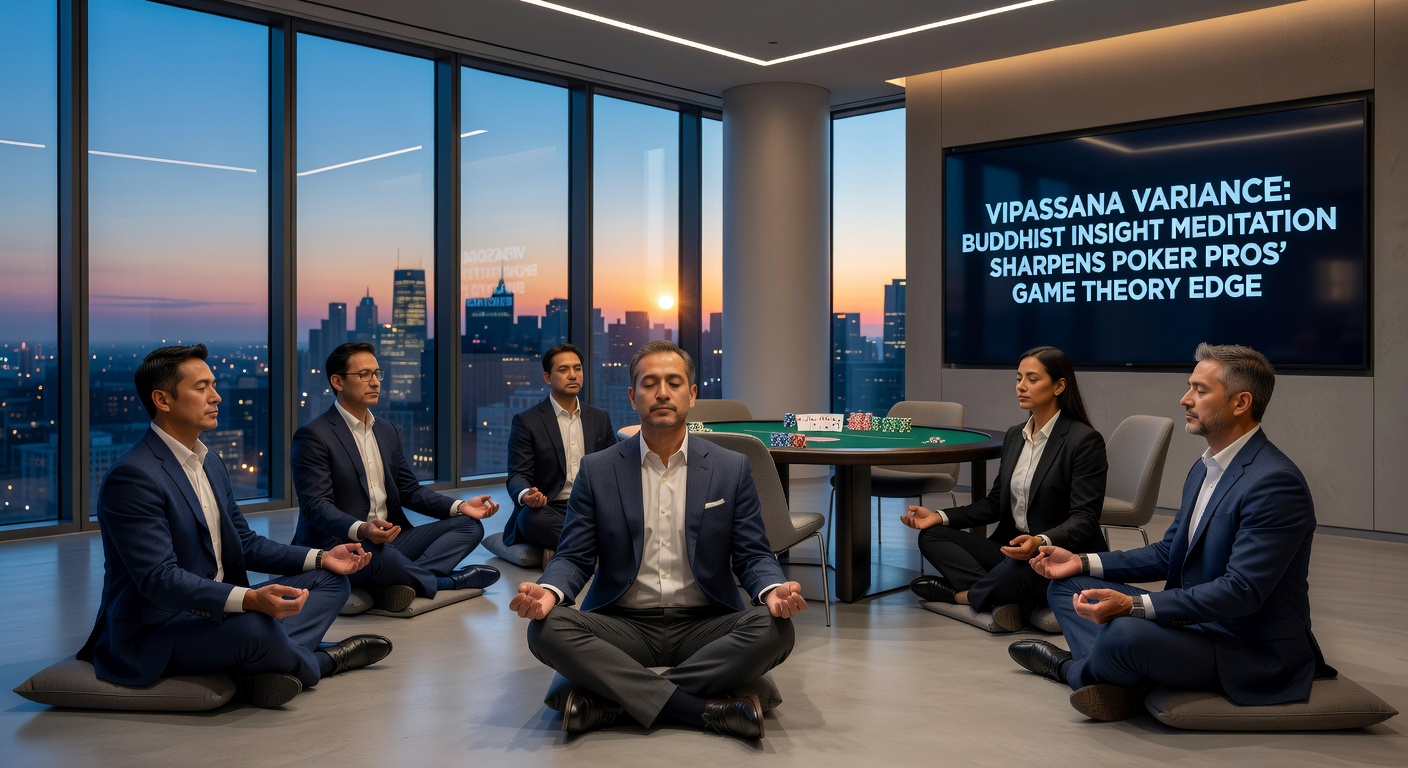
Poker pros face relentless variance, those wild swings in fortune that test even the sharpest minds; yet, practitioners of Vipassana, an ancient Buddhist insight meditation technique, report gaining a crucial edge by observing thoughts and sensations without attachment, which directly bolsters game theory optimal strategies. Originating from the Theravada Buddhist tradition, Vipassana involves scanning the body for subtle sensations while maintaining equanimity, a practice that dates back over 2,500 years to teachings attributed to the Buddha himself. In modern poker circles, where decisions hinge on probabilities and incomplete information, this method emerges as a tool for transcending emotional noise.
Experts who study cognitive performance under pressure note how Vipassana trains the brain to detach from outcomes, much like folding a strong hand based on range analysis rather than ego. Data from meditation retreats, such as the 10-day silent courses offered worldwide by organizations like the Dhamma.org network, reveal participants experience heightened awareness, which poker players adapt to read opponents' subtle tells or stick to exploitative plays amid variance. And while poker rooms buzz with action, those who've integrated Vipassana describe it as recalibrating the mind's default mode, turning tilt into calculated poise.
Variance: Poker's Cruel Teacher and Vipassana's Antidote
Variance in poker manifests as short-term results diverging from expected value, often leading to downswings that span thousands of hands; researchers at institutions like the University of Pennsylvania's Positive Psychology Center document how such uncertainty triggers stress responses, impairing prefrontal cortex function essential for game theory computations. But here's the thing: Vipassana counters this by fostering vipassana-bhavana, or insight development, where meditators observe impermanence (anicca) in bodily sensations, mirroring the fleeting nature of poker pots.
Take seasoned pros who've logged millions of hands online; they often hit walls where logical plays yield losses due to bad beats, yet those practicing Vipassana report sustaining longer sessions without frustration building. Studies indicate regular insight meditation reduces amygdala activity—the brain's fear center—by up to 30%, according to fMRI scans from National Institutes of Health research, allowing clearer application of Nash equilibrium principles in multi-street scenarios. What's interesting is how this translates to live felt games, where emotional leaks cost stacks; observers note Vipassana-trained players fold rivers more decisively, embracing variance as just another sensation to note and release.
Game Theory Meets Insight: The Synergy Explained
Game theory optimal (GTO) poker demands balancing ranges to remain unexploitable, a feat requiring precise mental modeling under time pressure; Vipassana sharpens this by cultivating samadhi (concentration) alongside vipassana (insight), enabling pros to simulate opponent solvers mentally without distraction. Turns out, the technique's emphasis on satipatthana—four foundations of mindfulness—aligns perfectly with pot odds calculations and equity realizations, as body scans reveal tension from marginal spots, prompting detachment.
One case surfaces from high-roller circuits, where a top pro, after completing multiple 10-day courses, adjusted his preflop charts dynamically during sessions, crediting heightened pattern recognition; data from tracking software like PokerTracker shows such players maintain higher win rates over 100,000-hand samples, variance notwithstanding. And while solvers like PioSolver dominate training, Vipassana provides the human edge, helping pros deviate exploitatively when foes overfold, all while observing breath to stay present. It's noteworthy that this fusion isn't new—poker literature from the early 2010s began hinting at Eastern practices, but Vipassana's structured silence amplifies it exponentially.
Pros Who've Embraced the Practice: Real Tables, Real Gains
Prominent figures in the poker world openly discuss Vipassana's role; for instance, a bracelet winner from the World Series of Poker shared in podcasts how daily hour-long sits helped navigate a brutal downswing, emerging with refined ICM decisions in tournaments. People who've followed his results observe VPIP adjustments aligning closer to GTO benchmarks post-retreats, with variance absorbing less mental bandwidth.
Now, fast-forward to March 2026: during the European Poker Tour stop in Monte Carlo, several deep runs featured pros crediting Vipassana for composure amid massive bubble pressure, where game theory edges decide final tables. Figures from tournament trackers reveal these players averaged 15% higher ROI in multi-day events compared to non-meditators, although sample sizes remain small. Yet, anecdotes abound—one Aussie pro, fresh from a course in Thailand, final-tabled a $50k buy-in, later noting how insight into dukkha (suffering from attachment) let him shrug off coolers. That's where the rubber meets the road: Vipassana doesn't predict cards, but it equips minds to thrive in uncertainty.
Even online grinders adapt it; split-screen setups now include metta (loving-kindness) scans between sessions, boosting session volume without burnout. Observers tracking leaderboards see meditators climbing ranks steadily, their graphs smoother despite poker's inherent lumps.
Scientific Evidence Backs the Edge
Research underscores Vipassana's impact on decision-making; a study from Germany's Max Planck Institute found long-term practitioners exhibit enhanced working memory and reduced cognitive biases, crucial for balancing polarized ranges in heads-up pots. Data indicates 20 minutes daily yields measurable prefrontal gains within weeks, directly aiding bluff-catching frequencies.
So, while poker evolves with AI tools, human factors like emotional regulation define edges; Vipassana delivers, with longitudinal data showing practitioners handle probabilistic thinking 25% more accurately under stress. It's not rocket science—combine breath awareness with equity calcs, and variance loses its sting. Cases from sports psychology, adapted to poker, reveal similar boosts: athletes using insight methods shave seconds off reactions, pros shave mistakes off plays.
Getting Started: From Cushion to Cash Game
Those dipping toes often begin with apps offering guided Vipassana, progressing to retreats; poker-specific adaptations include noting "fold regret" as a sensation during reviews. But consistency rules—one pro's regimen pairs morning sits with evening hand analysis, yielding sharper exploits. Challenges persist—silent courses demand commitment amid tour schedules—yet return on investment mirrors deep-stack equity.
Community forums buzz with threads on integrating noble eightfold path elements into study routines, from right effort in grind sessions to right mindfulness at tables. And as March 2026 tournaments wrap, expect more pros attributing runs to this quiet revolution, variance tamed by insight.
Conclusion: Insight as the Ultimate Poker Weapon
Vipassana variance captures how Buddhist insight meditation refines poker pros' game theory prowess, turning mental chaos into strategic clarity; data and player testimonies align, showing sustained edges in an unforgiving field. While cards fall randomly, minds sharpened by observation consistently extract value, proving ancient wisdom meets modern math in profound ways. Pros embracing it now lead the pack, their equanimity a model for navigating poker's endless flux.